



Knowledge Base: The Ultimate Event Planning & Print Logistics Checklist
Article Category: Event Management & Corporate Logistics Target Audience: Corporate Event Planners, Marketing Directors, Gala Organizers
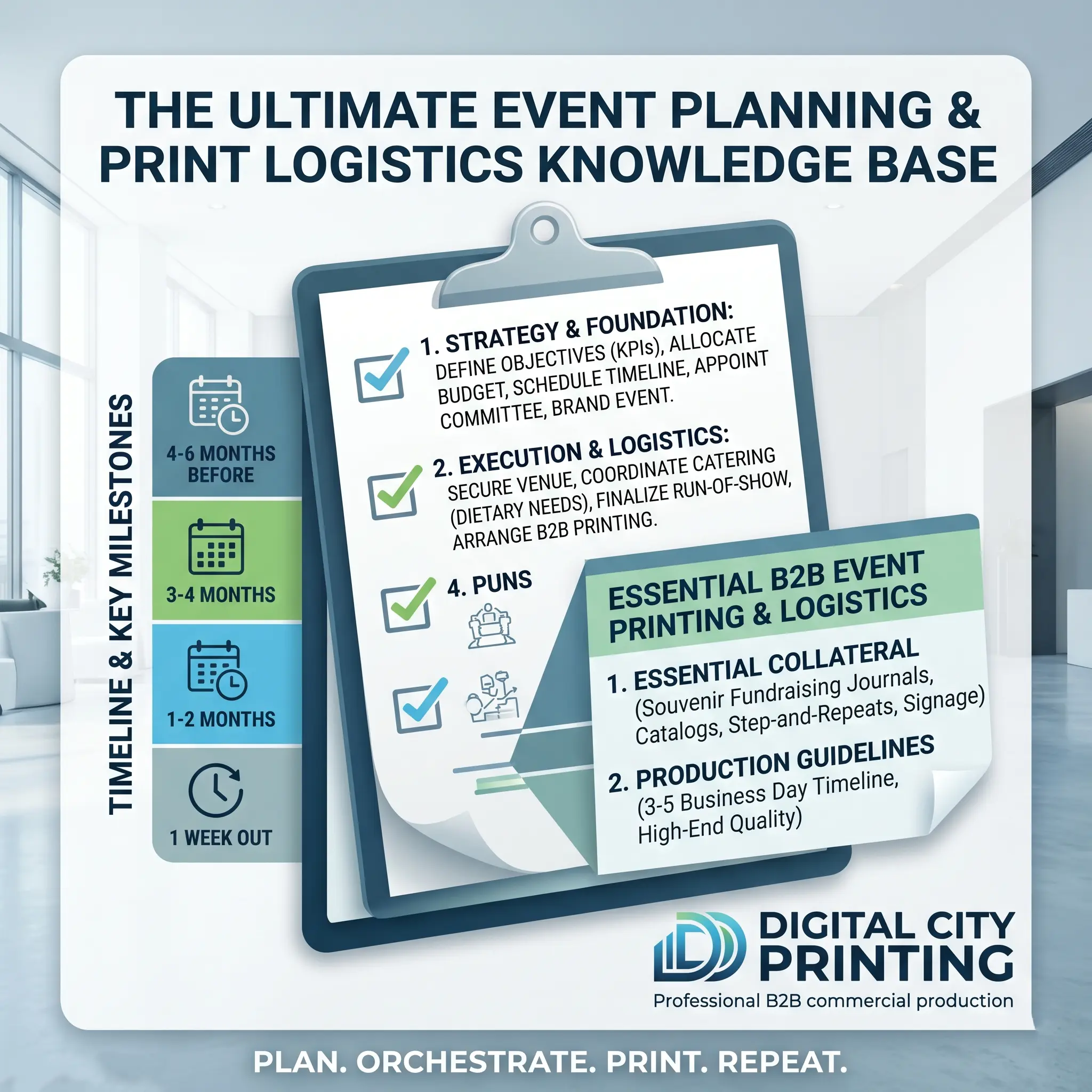
Executing a corporate summit, industry trade show, or charity gala requires strict adherence to logistical timelines and professional production standards. Based on industry best practices and our daily experience working with corporate planners in New York, we have developed this comprehensive event planning checklist. This guide will walk you through the entire lifecycle of an event—from 6 months out to post-event analysis—while highlighting the critical B2B print production guidelines necessary for a flawless physical brand experience.
Phase 1: 4-6 Months Ahead – Strategy & Foundation
1.1 Defining Core Objectives & Master Plan
Before initiating vendor contracts, establish a clear structural foundation.
-
Key Performance Indicators (KPIs): Identify quantifiable metrics for success, such as ticket sales, qualified lead generation, or fundraising totals.
-
Scale and Headcount: Draft a preliminary attendee list. The spatial and logistical requirements for a 50-person seminar versus a 1,000-person keynote dictate all subsequent venue and catering decisions.
-
Event Registration Software: Consider implementing an automated event registration and management platform early in the process to handle ticketing, attendee data, and automated reminders seamlessly.
1.2 Budget Allocation & Event Management
Establish a firm financial ceiling with categorized spending limits.
-
Standard Allocation: Venue (20-30%), Food & Beverage (30-40%), Professional Production & Printed Materials (15%), and AV/Entertainment (10%). Always mandate a 10-15% reserve fund for unanticipated shifts.
-
When to Contract an Event Management Company: Evaluating internal bandwidth is critical. Organizations should procure a professional event management agency when the guest list exceeds 500 attendees, the itinerary spans multiple days, or the production requires complex AV, staging, and VIP coordination. Event management firms provide established vendor networks, specialized contract negotiation, and dedicated crisis management. For high-stakes product launches, outsourcing to an experienced event planning agency mitigates risk and allows your internal staff to focus on networking rather than day-of troubleshooting.
Phase 2: 3-4 Months Ahead – Logistics & Sponsorships
2.1 Venue, Logistics & Catering
With the foundation set, start locking in the physical elements.
-
Logistics & Flow: Finalize AV equipment needs, stage setups, and directional flow through the venue.
-
Hospitality Formatting: Align the catering style with the event’s objective. Interactive buffet stations optimize networking, while plated services are standard for formal addresses. Institute a mandatory dietary requirement field during registration to ensure your caterer provides vegan, gluten-free, and allergen-safe accommodations.
2.2 Speakers, Sponsors & Publicity
-
Speaker Coordination: Confirm travel arrangements, gather bio information, and request presentation slides.
-
Sponsorship Packages: Finalize sponsorship tiers. Begin identifying the physical assets you will need to fulfill sponsorship promises, such as dedicated ad space in programs or branded step-and-repeats.
Phase 3: 1-2 Months Ahead – Essential Printed Materials & B2B Production
The physical materials distributed at an event are direct representations of corporate brand authority. Consumer-level printing introduces severe quality control and timeline risks. Transitioning your design files to a dedicated professional B2B production facility is a standard requirement.
3.1 Crucial Event Print Collateral
-
Souvenir Fundraising Journals: Essential for galas and charity events, these bound books act as beautiful keepsakes while fulfilling sponsorship agreements through structured ad placements.
-
Catalogs & Presentation Folders: Critical for trade shows and product launches to provide high-quality information to stakeholders.
-
Custom Die-Cut Stickers & Calendars: High-value promotional takeaways that extend brand visibility.
-
Directional Signage & Banners: Large-format displays that dictate foot traffic and reinforce brand presence.
3.2 Required B2B Production Timelines
At Digital City Printing, our production staff operates advanced high-end digital presses and specialty finishing equipment. Planners must integrate strict production windows into their master schedules:
-
Production Policy Notice: Same-day printing is strictly unavailable for calendars, catalogs, stickers, or any complex bound products. A mandatory 3-5 business day production window is required to ensure flawless, professional execution.
-
B2B Operational Workflow: We operate exclusively as a professional B2B printing partner. Our team processes high-volume, print-ready files directly one to one client service rep. We do not offer standard retail walk-in services, single-copy printing, or document scanning.
Phase 4: 1 Week to 1 Day Before – The Home Stretch
4.1 Run-of-Show & Briefings
-
Run-of-Show Documentation: Document exact timestamps for vendor load-ins, audio-visual sound checks, keynote addresses, and transition periods.
-
Team Briefings: Meet with committee chairs and volunteers. Assign specific zones of responsibility (e.g., registration desk manager, stage director) to ensure decentralized problem-solving.
-
Seating Plans & Registration: Provide final numbers to the caterer and print out finalized registration lists and name badges.
4.2 The Day Before
-
Signage & Setup: Ensure all directional signage, sponsor banners, and stage backdrops are placed correctly at the venue.
-
A/V Checks: Run through all presentations and test microphones, lighting, and cameras.
Phase 5: Post-Event Follow-Up & Analysis
The event isn’t truly over when the last guest leaves. Capitalize on the momentum within the first 48 hours.
-
Financial Reconciliation: Gather all final receipts, venue charges, and registration data to update your master budget.
-
Thank-Yous & Acknowledgements: Send personalized acknowledgment letters to sponsors, speakers, VIPs, and volunteers. Highlight specific successes, such as total funds raised or attendance milestones.
-
Post-Event Analysis: Send a post-event survey to attendees to learn what elements succeeded and what areas need improvement. Conduct an internal debrief with your team to review KPIs and begin strategizing for next year.
Facility Information & File Submission
Digital City Printing serves as New York’s premier B2B commercial print partner, operating advanced production facilities in Midtown Manhattan and Long Island City.
To secure a production slot and maintain your event timeline, submit all print-ready assets through our secure web-to-print portal.