

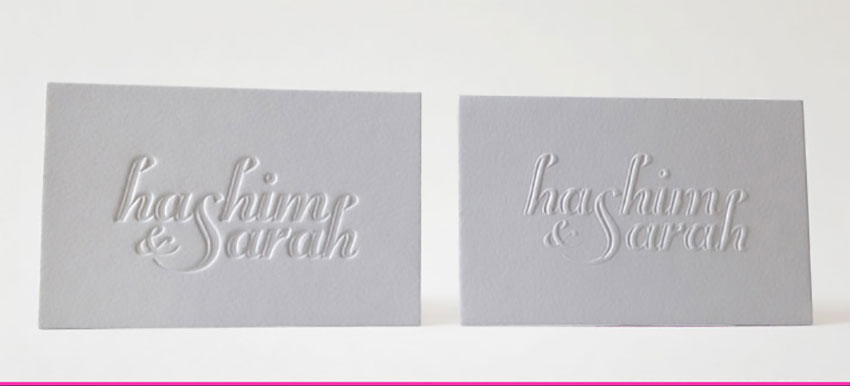
Custom Embossing & Debossing Services NYC | Traditional Die Printing
Digital City Printing produces true mechanical embossing and debossing for NYC agencies, designers, and luxury brands—using calibrated metal dies, not digital shortcuts, to create the tactile depth that separates premium print from everything else on the table.
What Traditional Die Stamping Actually Is
Custom embossing NYC projects at our shop start with a physical tool, not a file sent to a flatbed printer. A metal die—cut from brass or magnesium—is mounted on a press and forced into (or paired with a counter-die beneath) the paper stock under precisely calibrated tonnage, sometimes with applied heat, permanently reshaping the paper fiber itself. This is the mechanical process that separates real emboss and deboss printing from anything using ink, resin, or UV polymer to fake dimension.
There are three core variations of this technique, each with a distinct visual signature:
- Blind Emboss / Deboss: No ink or foil—just the shaped paper itself. Emboss raises the image above the surface; deboss presses it below. Often used on premium letterhead or the interior of our custom presentation folders.
- Foil Emboss / Registered Emboss (Combination Stamping): A foil-embossed printing die stamps metallic or pigment foil into the paper at the exact same moment it embosses, requiring the foil die and emboss counter-die to register in perfect alignment—this is the technique behind most debossed business cards NYC clients request when they want color plus texture.
- Multi-level / Sculpted Brass Dies: Hand-machined brass dies with varying depths and bevel angles within a single image, producing graduated, almost three-dimensional relief. Reserved for brass because only brass holds fine sculpted detail through long runs.
Interpretation of the artwork is only possible with brass dies, including shapes, textures, and edges. Magnesium is faster and cheaper for shorter runs but softens detail retention over time.
Blind Embossing vs. Foil Emboss vs. Sculpted Brass
| Technique | Ink/Foil Used | Visual Result | Best For |
|---|---|---|---|
| Blind Emboss/Deboss | None | Subtle, shadow-only relief | Letterhead, folder interiors, minimalist branding |
| Foil Emboss (Registered) | Metallic or pigment foil | Colored + raised, high registration precision | Luxury business cards, invitations |
| Multi-level Sculpted Brass | Optional | Graduated, contoured depth | Logos, monograms, high-end packaging |
Blind Embossing Services: What Sets Us Apart
Our blind embossing services rely on brass or magnesium dies—brass for longer runs and finer sculpted detail retention, magnesium for shorter runs and faster, more economical turnaround on simpler shapes. Every die is custom-cut for your artwork; nothing is reused or generic.
This same infrastructure supports our foil stamping services, since combination foil-and-emboss dies are typically machined from brass to withstand both heat and impact simultaneously.
Clearing Up Industry Confusion: Emboss vs. Thermography vs. Digital Spot UV vs. Engraving
Clients frequently confuse mechanically embossed printing with three other raised-print techniques that look similar in photos but perform very differently on press and in hand.
Thermography builds height by dusting resin powder onto still-wet offset ink, then baking it at high heat until it fuses into a glossy, raised layer sitting entirely on top of the paper. The reverse side stays completely flat—no impression at all—which is the fastest way to tell it apart from true embossing.
Scodix / Raised Digital Spot UV cures liquid polymer with UV light directly onto flat, already-printed stock in a digital inkjet process. Like thermography, it adds material on the surface rather than reshaping the sheet, so there's no fiber compression and no back-side texture—useful for photo-real spot effects but mechanically unrelated to die embossing.
Traditional Engraving uses a single etched plate that is inked and pressed into thick paper simultaneously, producing dense, tactile ink with a slightly raised feel and a characteristic "bruise" indentation on the reverse. Unlike blind embossing, engraving always deposits ink; unlike thermography, it always leaves a rear impression.
If depth-plus-color is the goal without full mechanical tooling costs, our specialty finishes page outlines when digital polymer builds make more sense than die stamping.
Why We Don't Emboss Both Sides of a Single Sheet
A single sheet of paper can only be mechanically reshaped once without conflict. If you emboss the front and then attempt to stamp the back, the second impression physically re-compresses and flattens the fiber structure created by the first, destroying the original relief. This isn't a policy preference—it's paper physics.
The professional workaround is duplex mounting: printing and embossing two separate sheets independently, then laminating them together face-out around a rigid core (2-ply, 4-ply, or heavier multi-ply glued board) so each side retains its own undisturbed impression. This is the standard construction behind our duplex-mounted luxury business cards and is also how we build multi-panel custom presentation folders that need texture on both interior and exterior surfaces.
Why Custom Die Stamping Cannot Be Rushed
Real emboss and deboss printing involves physical tooling, not a digital preset, so the timeline includes several sequential, non-skippable stages:
- CNC or chemical-etch die tooling: Brass dies are cut on CNC machinery; magnesium dies are chemically etched—both require design translation into precise depth maps before cutting begins.
- Counter-die make-ready: A matching counter-die (or make-ready packing) must be built to receive the male die's impression evenly across the full sheet.
- Press pressure calibration: Tonnage and heat are dialed in incrementally on press proofs to avoid paper cracking, ink cracking (on foil jobs), or uneven relief.
- Ink/foil cure time: On registered foil-emboss combination jobs, adhesive and foil transfer need to fully set before trimming, folding, or mounting.
Rushing any one of these stages risks a die that doesn't register, a sheet that cracks, or relief that flattens in transit—so realistic lead times run longer than standard flat printing.
Our Materials Policy: In-House Printing Only
We only perform embossing and debossing on stock printed in our own facility. We do not accept customer-supplied, pre-printed materials for die work.
This isn't an upsell—it's a technical safeguard. Guaranteed stock compatibility, correct grain direction, and pinpoint registration between printed image and die impression are only possible when we control the paper from print run through die strike. Outside stock introduces unknown grain orientation, coating variance, and moisture content that can crack fibers or misregister foil under pressure.
Best Paper Stocks for Embossing
Heavier, high-fiber-content stocks hold relief the longest and resist fiber fracture under tonnage:
- 130# Cover (350+ GSM) as the practical minimum weight for crisp, durable relief
- Cotton-based stocks like Mohawk or Crane's, prized for deep, long-lasting impressions on luxury business cards and invitations
- Uncoated or lightly coated finishes, which hold sharp die edges better than heavily coated gloss stocks
For artwork, keep minimum stroke weight at or above 0.5pt in vector format (AI, EPS, or vector PDF)—thinner lines risk breaking or filling in under die pressure, especially on debossed business cards NYC clients want with fine typography.
Ready to move a project from concept to metal die? Explore our foil stamping, business cards, presentation folders, or invitations & announcements to see which base product fits your embossing project best.
Ready to Start Your NYC Printing Project?
"Quality Printing Perfected. NYC Speed Guaranteed."
“Connect with our printing specialists today for a complimentary consultation and a same-day quote.”