

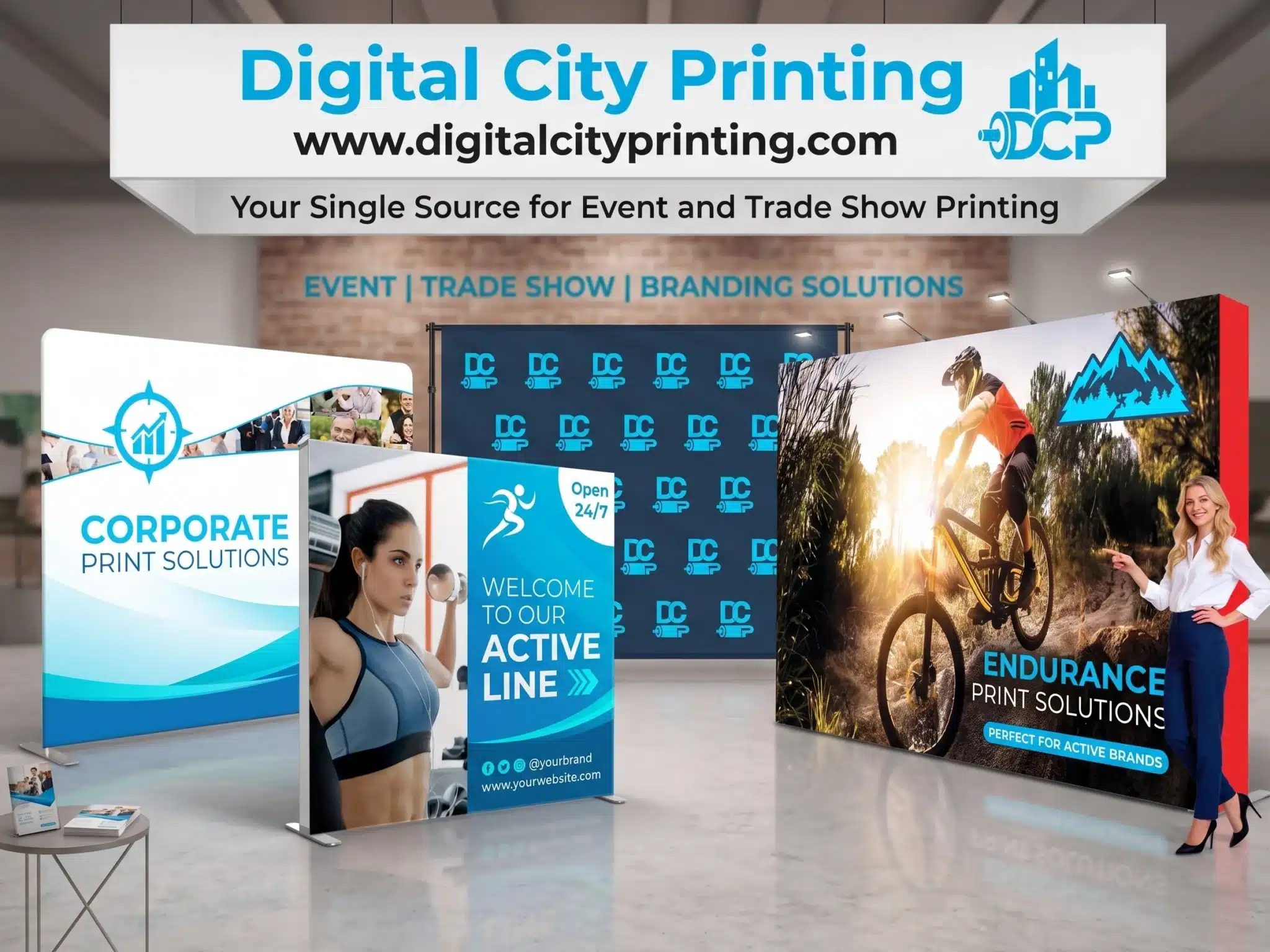
Trade Show Backdrop Stands: The Complete Guide to Hardware, Materials & Venue Compliance
Why Your Backdrop Stand Choice Matters
Choosing the wrong trade show backdrop stands can undermine months of preparation. The consequences ripple across every phase of your event: excessive baggage charges erode your budget, a failed fire-marshal inspection delays your move-in, and an unplanned labor call during setup can cost thousands under strict trade show union labor rules. At Digital City Printing, we’ve guided Manhattan marketing teams through these exact scenarios. A dependable backdrop program combines the right hardware, graphic material, travel plan, and venue-compliance documentation before the first crate reaches the loading dock.
This guide compares the principal event-display systems, explains when vinyl, pillowcase fabric, or SEG fabric backdrops make sense, and identifies the practical compliance questions to resolve before production. Understanding these distinctions protects your investment and ensures your brand commands attention on a crowded show floor.
What Makes a Backdrop Stand System Complete
A backdrop is never just a printed graphic hanging in space. The hardware mechanism influences setup time, transport cost, packed size, stability, and how easily graphics can be replaced between campaigns. The graphic media affects color saturation, glare under photography lighting, wrinkle recovery, opacity for backlit applications, and fire-code requirements that vary by venue and municipality.
Four hardware families dominate the event backdrop types category. Each serves distinct operational needs, from single-person airline travel to large-scale modular installations requiring rigging teams.
The Four Essential Backdrop Stand Systems
Telescopic / Step-and-Repeat Stands
Step and repeat stands remain the industry standard for media walls, sponsor backdrops, and red-carpet photography. These adjustable pole systems use dual base plates and telescoping upright poles that accept a horizontal crossbar. Graphics typically finish with 3-inch top and bottom pole pockets, allowing the banner to slide onto crossbars and tension between uprights.
Typical Assembly Process
- Extend upright poles and secure in weighted base plates
- Set desired width and height dimensions
- Thread banner pole pockets over top and bottom crossbars
- Adjust pole tension until graphic is taut
- Single-person setup: approximately 5–10 minutes
Operational Profile
- Lowest hardware investment among professional systems
- Widely available replacement parts
- Compatible with many pole-pocket vinyl and fabric banners
- Weighted bases add transported bulk
- Outdoor deployment requires sandbags or additional ballast
Travel Considerations
A typical case measures 24–48 inches and weighs 15–25 lbs. Most carriers set standard checked-bag thresholds at 50 lbs and 62 linear inches, but operating policies vary significantly. Always confirm your specific airline’s baggage allowances before travel—assumptions about dimensional weight can trigger unexpected fees at check-in.
Accordion Pop Up Display Systems
An accordion pop up display uses an expanding aluminum scissor or lattice frame that locks into straight or curved configurations. Graphics attach as either Velcro-backed fabric panels or magnetic PVC channel bars, depending on the specific system generation.
Setup Characteristics
- Expand frame until all locking points engage
- Position and level the freestanding structure
- Attach graphic panels via Velcro or magnetic channels
- Experienced operators: under two minutes for basic walls
- Real show conditions including unpacking and alignment: 10–15 minutes
These systems excel when speed matters. Many rolling cases convert to podiums or literature counters with optional wrap graphics, maximizing utility in compact booth spaces. However, panel configurations are often frame-specific, and Velcro attachment surfaces degrade after repeated installations. Large rolling cases frequently exceed standard baggage dimensions, requiring advance freight coordination for distant shows.
Pillowcase Tension Fabric Displays
When evaluating tension fabric vs vinyl backdrop options for frequent travel, pillowcase systems offer compelling advantages. These displays combine lightweight push-button aluminum tube frames with dye-sublimated polyester graphics that slip over the frame and zip closed.
Assembly Workflow
- Connect labeled snap-tube segments
- Raise completed frame to full height
- Pull fabric slipcover over frame like a pillowcase
- Zip graphic closed along hidden edge
- Single-person assembly: 5–8 minutes for 8–10 ft frames
Performance Attributes
Seamless presentation with minimal glare distinguishes these systems. The polyester fabric resists wrinkling once tensioned, and double-sided configurations enable freestanding layouts that maximize visibility in island booth configurations.
Some 8–10 ft kits pack below 16 lbs, creating genuine airline travel friendly backdrop potential. However, carry-on eligibility depends on case dimensions and carrier-specific route allowances. International carriers often enforce cabin weight limits near 7 kg (15.4 lbs), and policies vary by aircraft type and departure airport.
Critical Compliance Note
A compact carry bag provides no automatic fire-code compliance. If your show requires NFPA 701 fire retardant backdrop certification, carry physical documentation and verify that printed fabric bears the required permanent compliance label sewn into the hem or printed edge.
SEG Fabric Backdrops
Silicone Edge Graphics represent the premium tier of trade show booth backwall systems. A dye-sublimated polyester graphic receives a thin silicone welt sewn around its perimeter. This edge presses into a recessed channel in a precision aluminum extrusion frame, pulling the graphic taut while completely concealing the finished edge.
Professional Installation Sequence
- Build and level labeled aluminum frame sections
- Seat graphic corners first to anchor position
- Press silicone edge along each side, working from corner toward center
- Distribute tension evenly to prevent puckering
- For backlit systems: complete LED installation and power verification before fitting fabric
Advantages for High-Value Presentations
The frameless appearance delivers executive-level presentation quality. Crisp, even tension eliminates visual distractions. Concealed edge finishing maintains clean sightlines. Graphic swaps require no tools—simply peel and replace segments as campaigns evolve.
System Investment Considerations
Higher frame investment than telescopic or tubular alternatives. Graphics must be manufactured to exact frame profile specifications; silicone-edge dimensions are not universal across manufacturers. Full-size rigid frames generally require freight shipment rather than personal airline transport.
Lighting Integration
SEG excellence extends to illuminated applications. Edge-lit and backlit SEG systems transform booth environments with diffused, even illumination that vinyl alternatives cannot replicate. For technology showcases, pharmaceutical presentations, or luxury brand activations, this capability justifies the additional planning complexity.
Material Selection: Matching Substrate to Environment
Vinyl Backdrops
Scrim vinyl dominates outdoor and high-traffic environments. Its woven reinforcement resists tearing, and surface treatments accept aggressive cleaning. For step and repeat stands receiving constant photographer contact, 13 oz or 18 oz vinyl provides abrasion resistance that fabric cannot match.
Vinyl’s limitations include specular glare under direct lighting and permanent creasing when folded incorrectly. It does not qualify for many indoor fire-code exemptions that fabric alternatives receive.
Tension Fabric Options
Polyester tension fabric offers superior dye-sublimation color saturation and essentially wrinkle-free presentation when properly tensioned. Its lighter weight reduces shipping costs and enables configurations impossible with rigid substrates.
For NFPA 701 fire retardant backdrop compliance, specify inherently flame-resistant polyester or post-treated fabric with certified documentation. Digital City Printing maintains current compliance certificates for all major venue jurisdictions, including Javits Center, McCormick Place, and Las Vegas Convention Center requirements.
Hybrid and Specialty Applications
Some campaigns benefit from material combinations: vinyl lower sections for durability in high-contact zones, tension fabric upper panels for visual refinement. Custom SEG elements integrated with standard tubular frames create modularity without full premium investment.
Navigating Trade Show Union Labor Rules
Venue labor regulations surprise unprepared exhibitors. Major convention centers require union carpenters for assembly exceeding specific thresholds, electricians for any hardwired connections, and riggers for overhead suspension. These rules apply regardless of your booth staff’s technical competence.
Pre-Production Compliance Checklist
- Confirm whether your backdrop stand requires tools for assembly
- Verify if your graphic attachment method qualifies as exhibitor-installed
- Determine power requirements and corresponding electrician mandates
- Review freight unloading protocols—drayage charges accumulate quickly
- Obtain required fire retardant certificates before shipping
Tool-free systems generally qualify for exhibitor installation, preserving budget for customer-facing activities. Document your system’s compliance characteristics in advance; show management inquiries during move-in generate costly delays.
Selecting Your Optimal Backdrop Stand Configuration
Decision Framework by Use Case
Frequent Air Travel, Single-Person Operation
Pillowcase tension fabric displays minimize packed weight and setup complexity. Verify carry-on dimensions against your primary carriers’ published limits. Budget for occasional checked-bag scenarios when route restrictions tighten.
Photography-Focused Activations
Step and repeat stands with matte vinyl graphics control glare for professional image capture. Maintain multiple banner sets for sponsor rotation without hardware replacement.
Premium Brand Presentations
SEG fabric backwalls deliver the refined aesthetic that marketing directors demand. Plan freight logistics and advance warehouse delivery to avoid rush drayage premiums.
Modular, Multi-Show Programs
Accordion pop up display systems with interchangeable fabric panels enable campaign evolution while retaining core hardware investment. Evaluate case-to-podium conversion options for space-efficient booth design.
Documentation and Quality Assurance
Professional backdrop programs include comprehensive production files and compliance documentation. At Digital City Printing, every tension fabric vs vinyl backdrop order ships with:
- Print-ready PDF proofs with color-managed output specifications
- Hardware assembly instructions with QR-linked video demonstrations
- Numerical frame segment labeling for error-free setup
- NFPA 701 or California Title 19 fire retardant certificates as required
- Care and cleaning guidelines extending graphic service life
Final Recommendations for Backdrop Stand Investment
The ideal trade show backdrop stands balance immediate functional needs against long-term program flexibility. Specify hardware that accommodates graphic refresh without complete replacement. Select materials appropriate to your primary venue types—indoor compliance requirements differ substantially from outdoor durability demands. Document compliance credentials before production completes, not during freight loading.
Your backdrop represents substantial brand investment. The hardware transporting and displaying that investment deserves equal consideration. Whether you require an airline travel friendly backdrop for quarterly regional shows or a modular SEG system for annual flagship presentations, technical planning prevents operational surprises.
Digital City Printing produces backdrop stand systems for Manhattan marketing teams, global brand activations, and everything between. Our Midtown production facility delivers same-day proofs, rapid turnaround on graphic replacement, and direct courier service to Javits Center and regional venues. Every system ships with compliance documentation, assembly guidance, and dedicated support through your event completion.
Connect with our printing specialists for complimentary consultation, material samples, and detailed quotations tailored to your program requirements.